How to Fix AI Misinformation About Your Brand
- Jowita Chmura
- Ai brand monitoring
- Published
- Last updated
- 08 Mins read
If you need to fix AI misinformation about your brand, don’t start by rewriting every page or begging a chatbot feedback form to behave. Start with the sources those systems can find, cite, and reuse: your website, structured data, third-party profiles, reviews, comparison pages, and old articles.
The mistake is treating one bad AI answer like a support ticket. It is usually a source-quality problem, a stale entity problem, or a monitoring problem.
[Reality Check]: You cannot force an answer engine to say the exact sentence you want, but you can make the correct version easier to find, verify, and repeat.
What counts as AI misinformation about a brand?
AI misinformation about a brand is any generated answer that gives buyers the wrong picture of who you are, what you sell, where you operate, who owns the company, which products you support, or how you compare with competitors.
Common examples:
- A chatbot says your SaaS product is only for enterprises when you also serve startups.
- An answer engine lists a discontinued feature as a current selling point.
- Perplexity cites an old review page that names the wrong pricing model.
- Gemini or Google AI Overviews connect your brand to a category you have left.
- ChatGPT recommends competitors for your core use case and describes your product as a weaker fit.
This is not only a PR problem. It affects AI search visibility, brand reputation risk, and the buyer shortlists that happen before anyone clicks your site.
Start with an answer audit, not a rewrite
Before changing pages, capture the bad answers. You need evidence, not panic screenshots.
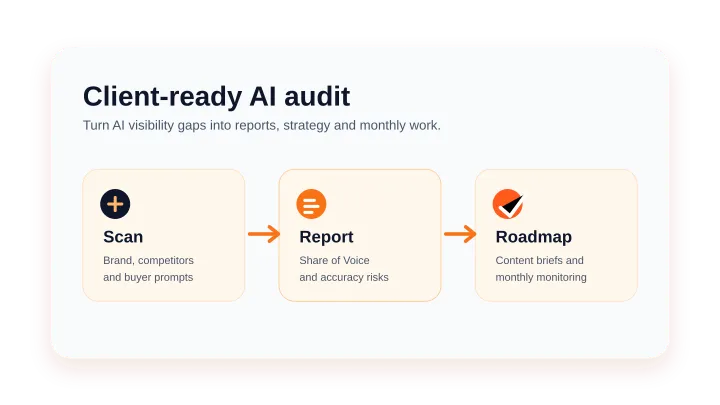
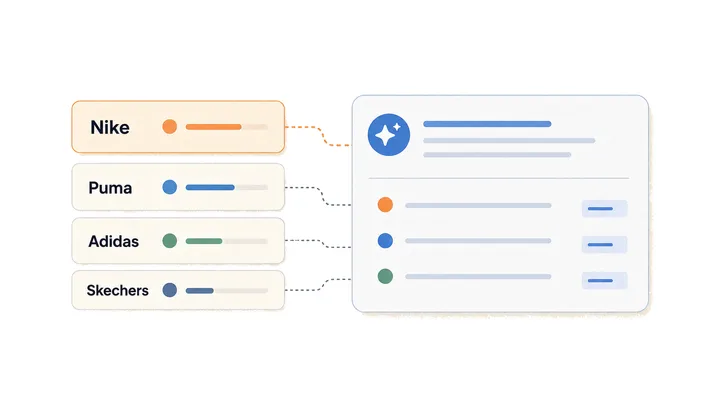
Run the same prompts across the answer engines that matter to your buyers. For most B2B teams, that means ChatGPT, Perplexity, Gemini, Claude, Copilot, and Google AI Overviews where available. Label every result by date, platform, prompt, answer, cited sources, competitors mentioned, and exact error.
Then prioritize by business risk. A wrong headquarters address is annoying. A wrong security posture, acquisition rumor, discontinued product claim, or competitor recommendation on a high-intent query deserves faster action because a buyer may use it to rule you out.
Use this triage order:
- Revenue risk first: prompts about alternatives, best tools, pricing posture, integrations, implementation fit, or vendor shortlists.
- Trust risk second: claims about ownership, legal name, support, reliability, reviews, compliance posture, or whether the company is real.
- Positioning drift third: descriptions that flatten the product into the wrong category or miss the use case you actually sell.
- Cosmetic errors last: wording you dislike, but that would not change a buyer’s decision.
This keeps the repair plan sane. Without triage, teams spend a week polishing an About page while the answer engine keeps recommending a competitor for the prompt that actually matters.
Use a simple error taxonomy:
| Error type | What to capture | Likely fix |
|---|---|---|
| Wrong company facts | founding date, location, leadership, ownership, product line | source-of-truth page, Organization schema, profile cleanup |
| Outdated product info | retired feature, old pricing, old positioning | product pages, changelog, comparison pages, third-party corrections |
| Weak category fit | AI puts you in the wrong market | homepage positioning, category pages, entity consistency |
| Competitor displacement | competitor recommended instead of you | comparison content, proof pages, source/citation gap analysis |
| Risky claim | legal, security, support, integration, or pricing claim is wrong | official documentation, FAQ, support page, correction requests |
For a manual first pass, use the DIY AI SEO brand audit. For recurring checks, build from the AI reputation risk scanner and the AI visibility prompt library.
Build one source-of-truth page the AI can understand
If your own website does not state the correction clearly, third-party cleanup becomes harder. Create or improve a source-of-truth page that answers the factual questions answer engines tend to compress.
Include:
- official company name, legal name, product name, and website URL;
- current product categories and use cases;
- supported markets, languages, and customer types;
- current pricing posture if public, or a clear “contact sales” statement if pricing is not public;
- leadership, ownership, office, and support facts where relevant;
- links to official social profiles, app listings, documentation, review profiles, and press pages;
- a short FAQ that answers the claims AI tools keep getting wrong.
Do not bury these facts in a brand manifesto. Put them in clean headings, short paragraphs, tables, and FAQ answers. A human should be able to verify the correction in under 30 seconds.
Add structured data, but do not oversell it
Structured data helps search systems understand page entities and relationships. It is not a magic override for AI answers. Google says structured data can help it understand page content and recommends JSON-LD when possible in its structured data documentation.
For brand misinformation, start with Organization schema on the homepage or source-of-truth page. Use sameAs to connect official profiles and reference pages. If the article uses FAQs to correct repeated errors, add FAQPage schema where it matches the visible content.
A basic Organization JSON-LD pattern looks like this:
<script type="application/ld+json">
{
  "@context": "https://schema.org",
  "@type": "Organization",
  "name": "Your Brand Name",
  "legalName": "Your Brand Legal Name, Inc.",
  "url": "https://www.yourbrand.com",
  "logo": "https://www.yourbrand.com/logo.png",
  "sameAs": [
    "https://www.linkedin.com/company/yourbrand",
    "https://www.crunchbase.com/organization/yourbrand",
    "https://www.youtube.com/@yourbrand"
  ]
}
</script>
Then validate it. Use Google Search Console URL Inspection, a structured data validator, and a crawl check to confirm the page is indexable. A noindex, blocked route, broken canonical, or JavaScript-only fact table can make the cleanest correction invisible.
Correct the sources AI systems already trust
Your website is one source. AI-generated brand descriptions may also reflect search results, third-party profiles, media articles, review sites, community posts, knowledge graph data, product directories, and old comparison pages.
Work through the visible source layer:
- Search the exact wrong claim in Google and Bing.
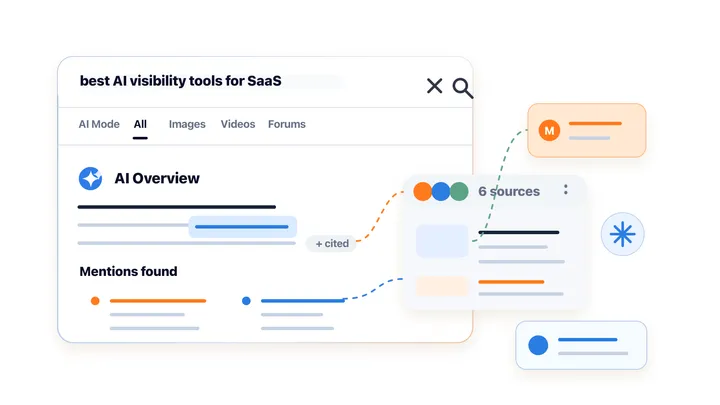
- Check the cited sources in Perplexity, ChatGPT Search, Google AI Overviews, and any AI answer that shows links.
- Update official profiles: LinkedIn, Google Business Profile, app marketplaces, product directories, GitHub, Crunchbase, G2, Capterra, or industry-specific listings.
- Ask publishers to correct outdated articles when the error is factual and material.
- Publish a concise clarification page if the wrong claim keeps recurring and you need a durable reference.
This is the slow part. It is also the part most teams skip.
Platform-specific repair notes
ChatGPT and ChatGPT Search
OpenAI says ChatGPT Search can provide timely answers with links to web sources and may choose to search the web based on the prompt, with source links shown in the answer experience in its ChatGPT Search announcement. That means you should separate two cases:
- The answer cites a bad source. Fix or outrank the source, then retest.
- The answer gives no source. Submit feedback, but also improve entity clarity and source coverage because the model may be relying on older or broader public information.
When you send feedback, quote the incorrect sentence, give the corrected fact, and include the official source URL. Do not write “this is wrong” and expect a durable repair.
Gemini and Google AI Overviews
For Google surfaces, start with crawlability, entity clarity, Knowledge Graph consistency, and structured data. Make sure Google can index the source-of-truth page and that your organization details match across your site, Google Business Profile, social profiles, and public databases.
If the wrong answer is tied to a specific page, improve that page first. If the wrong answer is tied to a public profile, correct the profile and give Google time to recrawl it.
Perplexity
Perplexity is useful for diagnosis because it exposes citations more often than many chatbot experiences. Its own docs distinguish raw search results from generated answers with built-in citations in the Perplexity Search API documentation.
When Perplexity gets your brand wrong, inspect the citations before rewriting your whole website. If the cited page is outdated, fix that page or create a stronger official answer that can compete for the same query.
Claude
Claude may not show the same live-source behavior for every user, plan, or context. Treat Claude errors as a long-term source and wording problem unless you have an enterprise support path. Your best repair lever is boring but reliable: make the correct facts consistent across public, reputable, easy-to-parse sources.
Grok and X
For Grok, monitor public conversation as well as owned pages. Pin corrections on the official X account when the error is spreading there, but do not rely on social posting alone. A pinned post is a signal. It is not a source strategy.
[Audit Checklist]: 30-minute AI misinformation repair pass
Use this when leadership asks, “Can we fix what AI says about us?”
- Capture 10 branded prompts: “What is [brand]?”, “Is [brand] legit?”, “Who owns [brand]?”, “What does [brand] cost?”, “Best alternatives to [brand]”, and five buyer-intent prompts from your category.
- Run them across at least three answer engines and save date, model/platform, answer, citations, and competitors.
- Classify each issue as wrong fact, outdated fact, missing context, competitor displacement, unsupported risk claim, or weak citation.
- Pick one official page to become the correction target.
- Add the corrected fact in visible copy, not only metadata.
- Add or update Organization, Product, and FAQ structured data where it matches visible content.
- Fix public profiles and third-party pages that repeat the error.
- Retest the same prompt set weekly until the answer stabilizes or the source pattern changes.
How to prevent the same error from returning
Fixing one answer is less useful than building an AI brand monitoring routine. Answer engines vary by platform, date, prompt wording, language, and source availability. A correction can appear in one system and fail in another.
Set up a monthly or weekly benchmark:
- Branded accuracy prompts: company facts, product description, pricing, ownership, support, security, integrations.
- Category prompts: where the buyer asks for tools, vendors, examples, or recommendations.
- Comparison prompts: “[Brand] vs [competitor]” and “best alternatives to [brand].”
- Reputation prompts: trust, complaints, reviews, scams, reliability, and limitations.
- Citation checks: which sources appear, which sources disappeared, and whether old pages keep resurfacing.
Track trends, not one-off wins. If an answer improves once but falls back the next week, you do not have a durable fix yet.
AI Brand Scan is built for this kind of work: repeated prompts, answer captures, source tracking, competitor visibility, and practical next actions. The AI visibility monitoring for B2B SaaS use case shows how to turn this from screenshot hunting into a repeatable workflow.
FAQ
How long does it take to fix AI misinformation about a brand?
There is no universal timeline. If the bad answer cites one outdated page you control, you may see improvement after recrawl and retesting. If the claim appears across third-party profiles, old media, reviews, and model memory, expect a longer cleanup cycle.
Can feedback buttons fix the problem?
They can help, especially for clear factual errors, but they are not a full strategy. Feedback is strongest when you include the exact error, the corrected fact, and a source URL. The source layer still needs repair.
Should we create a page just for AI tools?
Create a page for humans first: journalists, buyers, partners, analysts, and customers. Make it structured enough that search systems and answer engines can parse it. A useful source-of-truth page beats a thin “AI facts” page written only for crawlers.
Is this different from SEO?
Yes and no. Classic SEO still matters because crawlability, authority, internal links, and clear content affect what systems can find. The difference is measurement: AI brand monitoring checks generated answers, citations, recommendations, omissions, and competitor framing, not only rankings.
What to do next
If AI tools misdescribe your brand, start with a prompt benchmark and a source audit before rewriting random pages. Use AI Brand Scan to scan your brand in AI answers, compare what different answer engines say, and turn inaccurate claims into a prioritized correction plan.
Bring the evidence to the next content, SEO, or product marketing meeting: the prompt, the bad answer, the source behind it, the business risk, and the owner for the fix. That keeps the work operational. Nobody has to argue from vibes, and nobody has to pretend one clean answer means the issue is gone.