How Agencies Can Use AIbrandscan to Monitor AI Visibility for Clients
- Jowita Chmura
- Ai brand visibility
- Published
- 06 Mins read
How Agencies Can Use AIbrandscan to Monitor AI Visibility for Clients
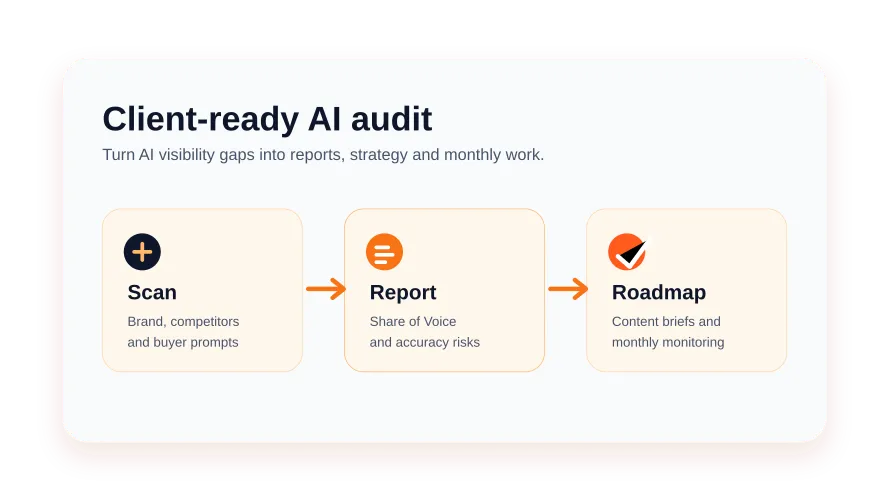
Agencies can use AIbrandscan to monitor AI visibility for clients by turning vague questions like “does ChatGPT mention us?” into a repeatable workflow: define buyer prompts, track client and competitor mentions, review answer accuracy, inspect sources, and turn the gaps into client-ready recommendations.
That sounds simple. It is not always simple in practice.
The easy version is taking screenshots from ChatGPT and dropping them into a slide deck. The useful version is building a benchmark that can be repeated next month without everyone arguing about whether the prompt changed, the model changed, or the screenshot was cherry-picked.
[Reality Check]: AI visibility reporting is only useful if the client can understand what changed and what to do next. A dashboard full of mentions is not a strategy.
There is a real evidence base for treating citations and source quality as part of the service. The foundational GEO research paper reported that optimization methods such as adding citations, statistics, and authoritative evidence can improve visibility in generative engine responses. More recently, a 2026 brand-reputation citation study found that LLM brand answers are grounded mostly in third-party domains, which is why agency reporting has to look beyond the client’s owned site.
Start with the client question
Most client conversations start in one of five ways:
- “Why does ChatGPT recommend our competitors?”
- “Are we showing up in Google AI Overviews?”
- “Can you help us with GEO?”
- “Does Perplexity cite our site?”
- “How do we report AI visibility to leadership?”
Do not answer all of those with the same generic audit.
First, decide what the client actually needs to know. A SaaS client entering a new category needs different prompts from a law firm worried about reputation risk. A B2B agency client may care about shortlist prompts. An ecommerce client may care more about product comparisons and review sources.
The first job is not scanning everything. It is choosing the right question.
Build a prompt set that matches how buyers ask
For most agency clients, start with 30 to 60 prompts. That is enough to find patterns without creating a reporting mess.
Use prompt groups instead of random examples:
| Prompt group | What it reveals |
|---|---|
| Branded prompts | Whether AI describes the client accurately |
| Category prompts | Whether the client appears when buyers ask for tools, vendors, or providers |
| Comparison prompts | Whether AI can explain the client against competitors |
| Alternative prompts | Whether the client appears when buyers are replacing another solution |
| Problem-aware prompts | Whether AI connects the client to the pain the buyer is trying to solve |
| Local or market prompts | Whether visibility changes by region, language, or buyer segment |
This is where many agency reports go soft. They test five dramatic prompts, find one bad answer, and build a scary narrative around it.
Use a benchmark instead. Same prompt group, same tracking fields, same cadence.
What AIbrandscan should track for each client
For each prompt, track more than whether the client’s name appears.
At minimum, capture:
- the prompt text;
- the answer engine or AI surface;
- the date of the scan;
- whether the client is mentioned;
- whether the client is recommended;
- which competitors are mentioned or recommended;
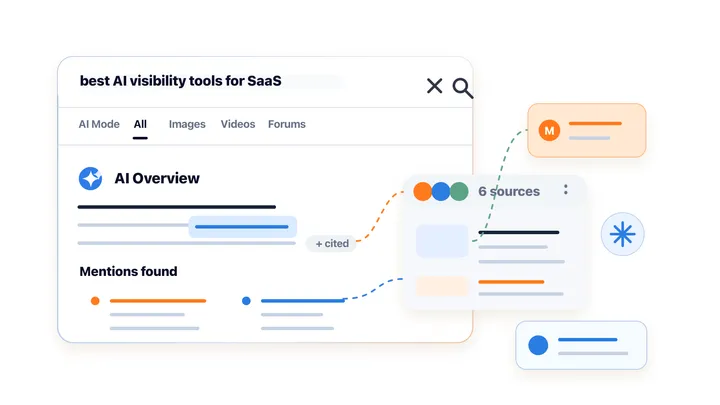
- whether the answer cites the client, a competitor, or a third-party source;
- whether the client’s description is accurate;
- whether the answer creates a content, source, or positioning task.
The distinction between “mentioned” and “recommended” matters.
A client can be mentioned in a throwaway sentence and still lose the buyer journey. A competitor can be recommended with a clear reason while the client is only listed as “another option.” That is not the same outcome.
Turn scan results into useful client reporting
Clients do not need a pile of raw AI answers.
They need the report to answer four questions:
- Where are we visible?
- Where are competitors winning?
- Is AI describing us correctly?
- What should we fix first?
A good monthly report can be simple:
| Report section | What to show |
|---|---|
| Executive summary | The biggest movement, risk, or opportunity |
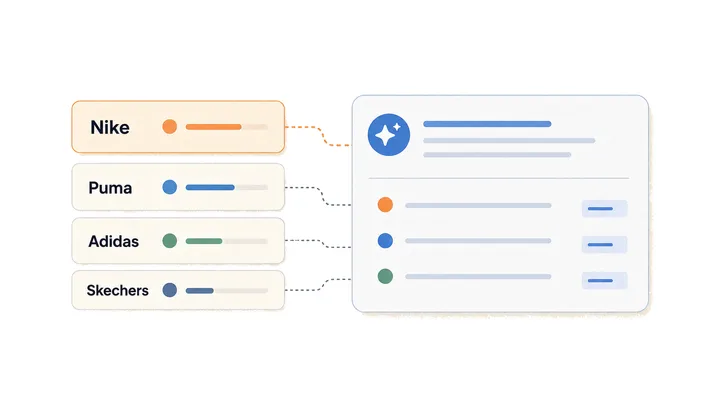
| Share of voice | Client vs competitor visibility across the prompt set |
| Prompt gaps | Prompts where competitors appear and the client does not |
| Accuracy issues | Wrong category, old positioning, missing features, or misleading claims |
| Source patterns | Pages, reviews, directories, or third-party sites that seem to influence answers |
| Recommended actions | The next 3 to 5 fixes, ranked by business value |
Avoid pretending this is classic rank tracking. There is no clean “position 2 in ChatGPT” metric that behaves like Google rankings. AI answers vary by prompt wording, model, date, source availability, and sometimes location or user context.
Say that clearly. Clients trust honest caveats more than fake precision.
A 2026 measurement study of Google AI Overviews found that nearly 30% of cited domains did not appear in the co-displayed first-page organic results. That does not make organic rankings irrelevant, but it is a useful client-facing caveat: AI answer citations are related to search visibility, not identical to rank tracking.
What agencies can actually sell
AI visibility can become a service, but it should not be packaged as magic.
The strongest agency offers are concrete:
- one-time AI visibility audit;
- monthly AI visibility monitoring;
- competitor visibility gap analysis;
- AI answer accuracy review;
- GEO content roadmap;
- comparison-page and alternatives-page planning;
- source cleanup and profile refresh;
- executive AI visibility summary.
The weak offer is “we will optimize you for ChatGPT.”
That promise is too broad. No agency controls the answer engine. What you can do is measure visibility, find weak public evidence, improve the client’s owned pages, clean up stale sources where possible, and monitor whether the pattern changes.
That is still valuable. It is just more honest.
For ChatGPT specifically, OpenAI says ChatGPT search can include source links and a references sidebar, and its crawler documentation describes OAI-SearchBot as the crawler used to surface websites in ChatGPT search features. For Google, the official AI features guidance still points back to core Search fundamentals: make helpful, crawlable pages that are eligible to appear in Search features.
The agency workflow
Use AIbrandscan as the measurement layer, then use your agency process to turn findings into work.
1. Set up the client
Add the client brand, website, category, market, competitors, and target language or region. Do not skip the competitor list. AI visibility is mostly comparative in commercial prompts.
2. Create the prompt benchmark
Start with the core prompt groups, then add client-specific prompts from sales calls, Search Console queries, support questions, competitor pages, and real buyer language.
3. Run the scan
Look for mentions, recommendations, competitors, citations, accuracy issues, and source patterns. Do not overreact to one answer. Look for repeated gaps.
4. Classify the problem
Most visibility gaps fall into a few buckets:
- The client’s category is unclear.
- Competitors have stronger comparison or alternatives pages.
- The client’s site lacks proof for the use case.
- Third-party profiles are stale or thin.
- AI is using outdated positioning.
- The prompt set does not match the client’s real buyer.
The fix depends on the bucket. “Write more blog posts” is not a diagnosis.
5. Create the roadmap
Turn findings into specific work:
- update the homepage category language;
- add a use-case section;
- create or improve comparison pages;
- write an alternatives page;
- strengthen FAQ answers;
- add internal links to the best evidence pages;
- refresh review profiles or directories;
- create a client-facing explanation for inaccurate AI answers.
Keep the list short. A client can act on five recommendations. They will ignore 37.
6. Re-scan and report movement
After changes ship, re-run the same prompt set. Do not declare victory from one improved answer. Look for pattern movement across the group.
What not to tell clients
Do not tell clients:
- “We can guarantee ChatGPT will recommend you.”
- “AI visibility is the new SEO and replaces search.”
- “You need 50 new AI SEO blog posts.”
- “This one screenshot proves the market sees you this way.”
- “The answer changed, so our fix worked.”
Those lines sound confident. They are not serious.
Better language:
- “Across this prompt set, your brand appeared in 8 of 50 answers.”
- “Two competitors were recommended more often in comparison prompts.”
- “AI describes your category inconsistently, which points to a positioning and source problem.”
- “The next useful fix is clearer comparison content, not another generic blog post.”
- “We need another scan after publishing before we call this movement.”
That is less flashy, but it is the kind of reporting clients can make decisions from.
Where AIbrandscan fits
AIbrandscan is useful when the agency needs a repeatable way to monitor:
- brand mentions;
- competitor mentions;
- recommendations;
- AI share of voice;
- answer accuracy;
- sentiment or framing;
- citations and source patterns;
- prompt-level visibility gaps;
- content opportunities.
The tool does not replace agency judgment. It gives the agency cleaner evidence.
The agency still has to decide what matters, which gaps are commercially important, and which fixes are worth the client’s budget.
A simple first client package
If you are introducing this service, do not start with a giant monitoring retainer.
Start with a focused audit:
- 40 buyer-intent prompts;
- 4 to 6 named competitors;
- 2 or 3 AI answer engines;
- one market or language;
- one report with findings and recommended actions;
- one follow-up scan after the first fixes ship.
That is enough to show whether the client has a real visibility problem.
If the audit finds repeated competitor displacement, wrong brand descriptions, weak citations, or missing use-case coverage, then monthly monitoring makes sense.
If the audit finds nothing meaningful, say that too. No-BS reporting includes telling the client when the signal is weak.
Bottom line
Agencies can use AIbrandscan to turn AI visibility from a screenshot exercise into a repeatable client workflow.
The job is not to manufacture anxiety about AI search.
The job is to show where the client appears, where competitors win, where AI gets the client wrong, and which fixes are most likely to improve the public evidence around the brand.
That is a service clients can understand. More importantly, it is a service an agency can repeat without pretending AI answers are more stable than they are.