How to Track Brand Mentions in Google AI Overviews
- Jowita Chmura
- Ai brand visibility
- Published
- 12 Mins read
How to Track Brand Mentions in Google AI Overviews
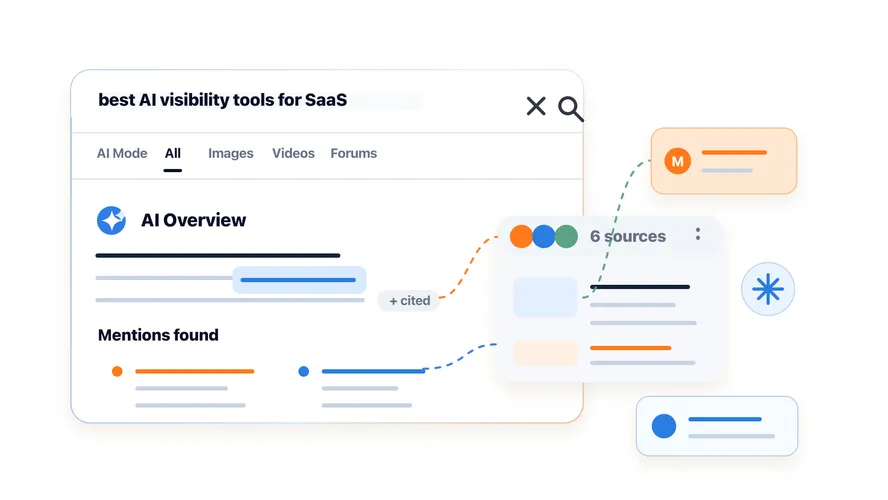
To track brand mentions in Google AI Overviews, build a repeatable query set, capture whether an AI Overview appears, record whether your brand is mentioned or cited, and compare that against competitor mentions and Google Search Console AI visibility data where available. Most teams get this wrong because they try to turn AI Overviews into a classic rank-tracking report with one tidy position number.
That is the wrong unit of measurement.
Google AI Overviews are generated answers inside Search. They can change by query wording, location, language, time, device, source selection, and whether Google decides an overview adds enough value for the search. A useful tracking workflow accepts that mess instead of hiding it.
Key takeaways
- Track query groups, not isolated keywords. A single query can mislead you.
- Separate four outcomes: brand mentioned, brand cited, brand URL shown, and competitor recommended.
- Use Google Search Console generative AI reporting when your property has access, but do not treat it as a full brand-mention monitor.
- Keep a dated evidence log with screenshots, cited sources, linked URLs, competitor names, and answer summaries.
- Report trends by prompt/query category: discovery, comparison, alternative, problem-aware, implementation, and branded accuracy.
- Use recurring monitoring because Google AI Overview visibility is not a fixed ranking.
Why Google AI Overview mention tracking is messy
Google gives site owners a clearer starting point than it did a year ago. Its Search Central guidance says AI features such as AI Overviews and AI Mode can surface links, use query fan-out, and vary from classic Search results. Google also says there are no special technical requirements beyond being indexed and eligible for Search snippets, while classic SEO basics still matter. See Google’s own AI features and your website documentation for the site-owner version of that guidance.
That helps, but it doesn’t solve brand monitoring.
Search Console can tell you whether pages from your site appeared in Google’s generative AI features when the reporting is available. It does not automatically tell you whether an AI Overview recommended your company, mentioned your competitor, framed your product correctly, or cited a third-party source that says something outdated about your brand.
There is a business difference between these events:
- Your pricing page appears as a supporting link.
- Your brand is named in the answer but not cited.
- A competitor is recommended and your brand is absent.
- Your brand appears only in a cautionary sentence.
- Google cites an old review, a forum thread, or a comparison page that misstates what your product does.
Those are not the same signal.
[Reality Check]: If your AI Overview report only counts whether your URL appeared, you may miss the more painful problem: the answer mentions three competitors and leaves your brand out of the buyer’s shortlist.
That is why tracking brand mentions in Google AI Overviews needs two layers: platform data and answer evidence.
Search Console is the platform layer. The evidence log is where the brand story lives.
Start with the query set, not the dashboard
The query set is the unit of measurement.
Not the keyword. Not the screenshot. Not the single exciting example someone dropped into Slack.
Start with 30 to 80 Google queries that map to how buyers actually research your category. For a B2B SaaS company, that usually means six groups:
- Discovery queries: “best [category] tools for [buyer type]” or “software for [specific workflow].”
- Problem-aware queries: “how to solve [pain] without [bad workaround].”
- Comparison queries: “[competitor] vs [competitor]” and “[category] comparison.”
- Alternative queries: “[competitor] alternatives” and “tools like [competitor].”
- Implementation queries: “how to set up [workflow]” or “[category] reporting template.”
- Branded accuracy queries: “what is [brand]”, “is [brand] good for [use case]”, and “[brand] pricing” when public pricing exists.
For Google AI Overviews, use real search language. Do not only track tidy SEO keywords like “AI brand monitoring software.” Track buyer phrases with constraints:
- “best AI visibility tools for B2B SaaS agencies”
- “how to monitor brand mentions in AI search”
- “Google AI Overview brand visibility tracking”
- “tools for tracking AI search citations”
- “why does Google AI Overview cite competitors”
Short queries can still matter, but AI Overviews tend to be easier to evaluate on question-like and research-heavy searches. The goal is not to trick Google into showing an overview. The goal is to observe the query space where buyers may see one.
If you already run SEO reporting, pull candidate queries from Google Search Console first. Use impressions, high-intent pages, comparison pages, and queries that sit near product-led content. Then add the missing natural-language variants that your customers actually ask.
AI Brand Scan’s AI visibility prompt library is useful here because the same thinking applies: the benchmark has to represent buyer jobs, competitor evaluation, and source questions, not just keyword volume.
What to capture for every Google AI Overview
Create a tracking sheet or monitoring table before collecting data. If you collect screenshots first and invent the fields later, you will lose consistency by week two.
For each query, capture these fields:
| Field | Why it matters |
|---|---|
| Query | The exact wording Google saw. Tiny wording changes can affect the answer. |
| Date and time | AI Overview behavior changes, and screenshots without timestamps age badly. |
| Country and language | Source selection and local competitors can differ by market. |
| Device | Mobile and desktop layouts can change what users see first. |
| AI Overview triggered? | No overview is still a result. Track non-triggers. |
| Target brand mentioned? | Basic visibility signal. |
| Target brand cited or linked? | Stronger signal than a mention because Google exposed a supporting page. |
| Target URL shown? | Useful for Search Console reconciliation. |
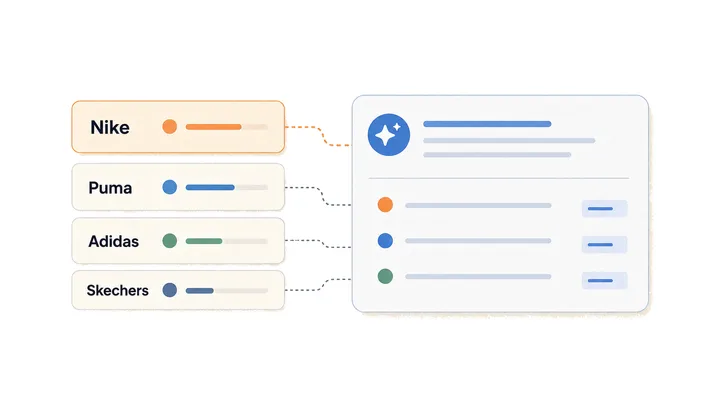
| Competitors mentioned | Shows displacement and category ownership. |
| Competitors cited | Shows which sources support competitor visibility. |
| Position in answer | First list item, middle mention, caveat, or buried after competitors. |
| Source domains | Owned site, review sites, directories, forums, documentation, news, or comparison pages. |
| Answer summary | One short human note about how the brand was framed. |
| Screenshot or HTML capture | Evidence for stakeholders and revision comparisons. |
| Follow-up action | Content gap, source gap, entity issue, reputation risk, or no action. |
This sounds heavier than a rank tracker. It is.
The payoff is that you stop arguing about anecdotes. A head of marketing can see that the brand appears in 2 of 20 comparison queries, gets cited in 0, and loses to the same two competitors in category-discovery prompts. That is a content and source strategy conversation, not a vague “AI search is weird” conversation.
For recurring work, connect this to AI SEO monitoring so the report becomes a trend line rather than a one-off audit.
Use Search Console, but know what it can and cannot answer
Google announced new Search Generative AI performance reports in Search Console on June 3, 2026. The announcement says the reports are designed to show impressions for pages in generative AI features such as AI Overviews and AI Mode, with views by pages, countries, devices, and dates. Google also said the rollout starts with a subset of websites before wider availability. The official announcement is here: Search Generative AI performance reports in Search Console.
Use that data if you have it. It can answer questions your manual tracker cannot answer at scale:
- Which URLs from your site appeared in generative AI features?
- Which countries generated visibility?
- Which devices were involved?
- Did impressions trend up or down after a content update?
- Which pages deserve closer manual review?
But do not confuse page visibility with brand visibility.
A page impression means a URL from your site appeared. It does not necessarily mean the answer recommended your product. It does not tell you the competitor set. It may not expose the exact wording that shaped the user perception. It also cannot show third-party sources that mention your brand unless those sources belong to you.
Use Search Console as the reconciliation layer:
- Export pages and dates from the generative AI report where available.
- Match those URLs to your manual query set.
- Flag pages that appeared in AI features but do not support a clear brand narrative.
- Find pages that should appear for important queries but never do.
- Compare country and device trends against your manual checks.
The ugly truth: Search Console can prove some visibility happened. It can’t replace the judgment work of reading the answer and deciding whether the brand mention helped or hurt.
Score mentions, citations, and competitor displacement separately
Do not build one vanity metric called “AI Overview visibility” and hide everything inside it. It will look neat in a deck and fail the moment someone asks why a competitor keeps showing up.
Use a simple scoring model:
| Outcome | Score | Interpretation |
|---|---|---|
| No AI Overview triggered | 0 | No answer surface to evaluate for that query run. |
| AI Overview triggered, target brand absent | 1 | Visibility gap. Competitor data matters here. |
| Target brand mentioned only | 2 | Some entity recognition, weak evidence exposure. |
| Target brand mentioned with neutral or useful framing | 3 | Better, but still check competitors and source quality. |
| Target brand cited or linked | 4 | Stronger evidence that Google surfaced a supporting page. |
| Target brand recommended with supporting source | 5 | Best practical outcome, still not a guarantee of traffic or conversion. |
Then add separate flags:
competitor_lead: a competitor appears before your brand.competitor_only: competitors appear and your brand does not.owned_source: your site is cited or linked.third_party_source: a review, directory, community, article, or partner page is cited.accuracy_risk: the answer includes stale pricing, wrong positioning, outdated features, or misleading comparisons.local_gap: your brand disappears in a country or language where you sell.
This separation matters because the fixes differ.
If your site appears but the brand is not recommended, the problem may be positioning clarity or answer framing. If competitors are cited from third-party pages and you are not, the problem may be source strategy. If a stale article is cited, the fix may be reputation cleanup or updated third-party evidence. If your own pages are eligible but never surfaced, the fix may involve content structure, internal links, crawl access, and page intent.
For competitor-heavy reports, pair this with an AI share of voice tracking prompt or a recurring AI share of voice tracking workflow.
The deep dive: distinguish a mention from a source
Here is the nuance most generic AI Overview advice skips: a brand mention and a source link are different things.
A mention means the generated answer included the brand name. A citation or supporting link means Google exposed a page as evidence or a next step. A URL impression in Search Console means a page from your site appeared somewhere in a generative AI feature report. These can overlap, but they are not identical.
Example:
- Query: “best tools to monitor brand visibility in AI search”
- AI Overview answer: names Vendor A, Vendor B, and your brand.
- Source panel: links to Vendor A’s comparison page, a software directory, and an industry article.
- Search Console: no URL impression for your domain.
You got a mention. You did not get a cited owned source.
That distinction changes the recommendation. A mention-only result may mean Google understands the entity but prefers other sources for evidence. Your next move is not “add the keyword ten more times.” It is to inspect what the cited pages contain: categories, comparison language, list structure, third-party credibility, review language, product attributes, and up-to-date claims.
Now flip the case:
- Query: “AI brand monitoring report template”
- AI Overview source panel: links to your blog post.
- Answer text: never names your product.
You got a source impression. You did not get brand recall.
That points to a different fix: the cited page may need clearer product-context sections, examples that name the use case, stronger internal links to the product workflow, and entity language that connects the brand to the problem. It may already be useful to Google as an information source, but weak as a brand visibility asset.
This is why your tracker should store four columns:
brand_mentionedbrand_recommendedowned_url_citedthird_party_source_cited
Don’t merge them too early. The executive summary can simplify later. The raw evidence should stay honest.
[Audit Checklist]: weekly Google AI Overview brand mention tracking
Use this checklist once a week for a lightweight operating rhythm. Agencies can run it monthly for lower-budget clients, but weekly catches source and competitor changes faster.
- Select 30 to 80 priority queries grouped by buyer intent.
- Run each query in the target country and language.
- Record whether an AI Overview appears.
- Capture the answer text or a short summary.
- Record whether the target brand is mentioned.
- Record whether the target brand is recommended, compared, cautioned against, or merely named.
- Record whether an owned page is cited or linked.
- Record all competitor mentions.
- Record competitor cited pages and source domains.
- Mark answer accuracy risks.
- Export Search Console generative AI data if available.
- Compare Search Console URL impressions with manual answer captures.
- Tag each gap as content, source, entity, technical, reputation, or no action.
- Choose 3 to 5 fixes for the next sprint.
- Save the evidence with date, country, language, and device.
Don’t overbuild the first version.
The first useful report is not a perfect data warehouse. It is a consistent table that a marketing lead can read without a 40-minute explanation.
Turn the findings into fixes
Tracking is only useful if it creates work your team can actually do.
Here is how to map findings to actions:
| Finding | Likely problem | Practical fix |
|---|---|---|
| Brand absent, competitors present | Category or source gap | Build comparison, alternative, and use-case content around the query group. |
| Brand mentioned, not cited | Weak owned evidence or stronger third-party sources elsewhere | Improve pages with direct answers, proof, examples, and source-worthy structure. |
| Competitor cited from directories | Third-party source gap | Update profiles, pursue credible listings, and monitor review/comparison pages. |
| Wrong product description | Entity or stale-source issue | Update owned pages, docs, product descriptions, and high-visibility third-party profiles. |
| Owned URL cited but brand not remembered | Content useful but brand weak | Add clear product context, internal links, author/entity signals, and examples. |
| Search Console AI impressions up, leads flat | Attribution or intent mismatch | Check query intent, page CTA, analytics paths, and branded-search lift. |
For reputation issues, connect the workflow to AI answer accuracy and brand misinformation checks. A wrong AI Overview is not always fixed by changing your homepage. Sometimes the cited source is old, the category language is muddy, or the strongest public evidence about your product comes from someone else.
For content gaps, turn the query groups into briefs:
- One page for the buyer problem.
- One page for the product category.
- One comparison or alternatives page when the query has BOFU intent.
- One evidence page with data, examples, FAQs, and clear terminology.
- One internal-link path from educational content to the product workflow.
This is where generative engine optimization becomes practical. You are not “optimizing for AI” in the abstract. You are making the public evidence around your brand clearer, easier to retrieve, easier to cite, and easier to compare.
A simple reporting format for stakeholders
Leadership does not need every screenshot. They need a clean answer to four questions:
- Are we visible for the queries that matter?
- Are competitors being recommended instead?
- Which sources shape the answer?
- What are we fixing next?
Use this reporting format:
| Section | What to show |
|---|---|
| Executive summary | 3 to 5 bullets on visibility, competitor displacement, and accuracy risk. |
| Query coverage | Number of tracked queries, AI Overview trigger rate, and query groups covered. |
| Brand visibility | Mention rate, recommendation rate, owned citation rate, and trend versus last period. |
| Competitor view | Top competitors mentioned, competitor-only queries, and repeated source domains. |
| Source analysis | Owned pages cited, third-party sources cited, stale sources, and missing source types. |
| Fix queue | Prioritized content, source, entity, and technical actions. |
| Evidence appendix | Screenshots, query text, date, country, language, and device. |
Keep the language sober. “AI Overview mention rate improved from 12 of 50 queries to 18 of 50 queries” is useful. “We now dominate AI search” is not.
If you use AI Brand Scan, the natural next step is to scan your brand in AI answers and turn the findings into recurring monitoring instead of scattered screenshots.
How often should you track Google AI Overview brand mentions?
Weekly is enough for most SaaS teams. Monthly can work for slower categories or agency retainers. Daily checks are usually overkill unless you are monitoring a crisis, a product launch, a news-heavy category, or a high-stakes reputation issue.
The cadence should match the decision cycle:
- Weekly: content teams, SEO teams, and active GEO work.
- Monthly: executive reporting and agency client summaries.
- Before and after launches: product messaging, comparison pages, rebrands, funding announcements, and major content refreshes.
- Incident-based: misinformation, legal risk, safety claims, or sudden negative coverage.
Track the same core query set over time. Add a small “experimental” group for new queries, but do not rewrite the benchmark every week. If the query set keeps changing, you are not measuring trend. You are collecting examples.
Common mistakes to avoid
The first mistake is measuring only branded queries. Branded accuracy matters, but buyers often ask category and comparison questions before they know what to search for. If your brand only appears when someone already names you, the AI Overview is not expanding your shortlist presence.
The second mistake is ignoring non-triggers. If Google does not show an AI Overview for 70% of your tracked queries, that is part of the report. It affects where AI Overview work matters and where classic SEO results still carry the page.
The third mistake is treating screenshots as strategy. Screenshots are evidence. They are not analysis. Every screenshot needs a query group, source note, competitor note, and recommended action.
The fourth mistake is using one location and one language for an international brand. If you sell in the UK, Germany, Poland, and the US, you need market-specific checks. Local competitors and local sources can win even when your English-language content looks strong.
The fifth mistake is assuming that a cited page equals a sale. AI Overview visibility may influence branded search, direct visits, comparison-page visits, partner-profile clicks, or later conversions. Some of that influence will not appear as a clean AI referral in analytics.
Measure what you can. Label what you infer. Don’t pretend the attribution is cleaner than it is.
FAQ
Can Google Search Console track brand mentions in AI Overviews?
Search Console can show visibility for pages from your site in Google’s generative AI features when the relevant reports are available. It does not fully replace brand mention tracking because brand mentions, competitor recommendations, answer framing, and third-party cited sources need answer-level review.
Is a Google AI Overview mention the same as a citation?
No. A mention means the brand name appears in the generated answer. A citation or supporting link means a page is exposed as evidence or a next step. You should track both because the fixes differ.
How many queries should I monitor?
Start with 30 to 80 queries. Smaller than that becomes anecdotal. Larger than that can be hard to review manually unless you already have a monitoring workflow. Group queries by buyer intent so the report stays readable.
Should I track competitors in every AI Overview?
Yes, for commercial query groups. Competitor mentions show displacement, category ownership, and source patterns. A query where three competitors appear and your brand is missing is more useful than a query where nobody appears.
Can I guarantee more Google AI Overview mentions by changing my content?
No. You can improve crawlability, content clarity, source quality, entity consistency, comparison coverage, and third-party evidence. You cannot guarantee that Google will mention, cite, or recommend a brand for a specific query.