Why AI Visibility Tracking Must Be Multilingual
- Jowita Chmura
- Ai brand visibility
- Published
- 09 Mins read
Why AI Visibility Tracking Must Be Multilingual
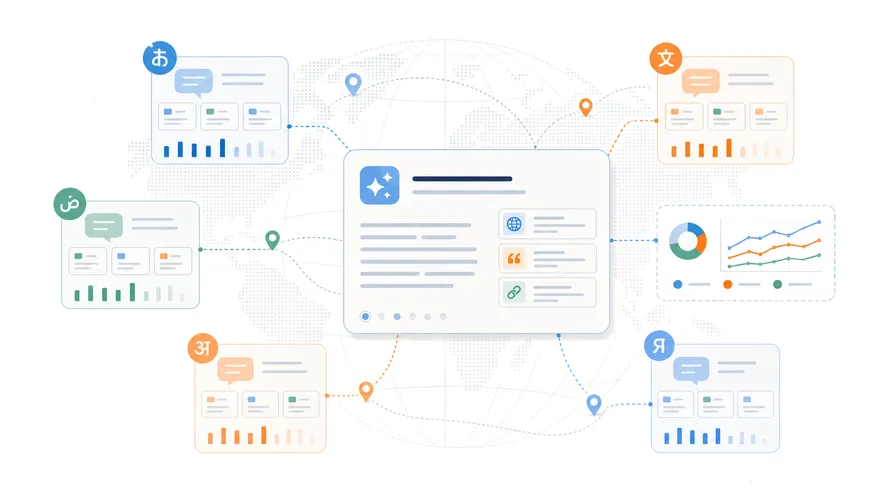
Teams must run multilingual AI visibility tracking when buyers research in more than one language, because answer engines can change sources, competitors, and recommendations when the language changes. The mistake most teams make is treating an English benchmark as proof that the brand is visible everywhere.
That is the uncomfortable part: English can be the easiest language to measure and still be the wrong language to trust.
[Reality Check]: A translated prompt set is not a multilingual visibility benchmark. It is an English benchmark wearing local-language clothes.
The penalty is not academic. It shows up as wrong recommendations, competitor-heavy shortlists, stale local descriptions, and reports that tell leadership the brand is fine in markets where buyers would never see it.
The maintenance burden is real: someone has to own local prompts, check local sources, and decide when a wrong recommendation is noise versus a pattern.
Key takeaways
- Multilingual AI visibility tracking shows whether your brand appears in the languages buyers actually use.
- Direct prompt translation is not enough. Local prompts need local vocabulary, local competitors, and local source checks.
- AI search visibility can change by language because source availability, market terminology, regional products, and answer habits change.
- Local-language omission is a business issue, not a translation issue. It can affect shortlists, comparisons, and category memory.
- Track language-level AI share of voice separately, then roll it up for executive reporting.
- Start with a small set of high-intent markets before trying to monitor every language at once.
- Multilingual source analysis matters because a 2026 study of LLM brand reputation citations found that citation patterns vary by language and market, not just by brand.
English-only tracking creates false confidence
Most AI visibility projects start in English for a practical reason: the team can read the results, the tools are easier to operate, and the first prompt list is usually copied from English SEO keywords.
That’s fine for a first scan.
It becomes risky when the English scan is treated as the market scan.
A SaaS company selling into Germany, Poland, France, Spain, and the United States does not have one buyer conversation. It has several overlapping conversations. Product category names differ. Buyers use different comparison terms. Review sites differ. Local media, directories, partner pages, and community threads differ. Even the competitor set can change.
Google has already taken AI-generated search answers beyond a single US-English surface. In its October 2024 AI Overviews expansion, Google said AI Overviews were rolling out to more than 100 countries and could appear in supported languages including English, Hindi, Indonesian, Japanese, Portuguese, and Spanish.
OpenAI’s ChatGPT search announcement points in the same direction for answer behavior: conversational search blends natural-language questions with web sources, follow-up context, and source links.
The practical implication is simple. AI search is not only a channel. It is a set of buyer-facing answer surfaces that can vary by language, region, source pool, and query wording.
If your AI brand monitoring ignores that, the dashboard is quieter than reality.
Translation is not localization
The first mistake is translating prompts word for word.
Take an English prompt like:
What are the best AI visibility tracking tools for B2B SaaS teams?
A direct translation may be grammatically correct and commercially weak. A Polish, German, or French buyer may not use the same category label. They may ask about AI search, ChatGPT visibility, brand monitoring in AI answers, answer engine optimization, GEO, or a local equivalent that has not settled into one neat acronym.
The prompt has to match market language, not the content team’s spreadsheet.
Use three levels:
| Level | What it means | When to use it |
|---|---|---|
| Translation | Same prompt, different language | Branded prompts and factual checks |
| Localization | Same buyer need, local wording | Category, use-case, and comparison prompts |
| Market-specific benchmark | Different prompt set for the market | Local competitors, regulations, buying habits, or product categories differ |
For AI Brand Scan, this changes the measurement workflow. The prompt set becomes the unit of measurement, but each language needs its own prompt logic. Start with the AI brand visibility audit prompt to define the core benchmark, then localize the prompts where buyer language differs.
Don’t bury the difference in a footnote. Label it in the report.
What changes when the language changes
Multilingual AI search visibility can change for boring, expensive reasons. Those are the reasons worth tracking.
The source pool changes
An English answer may lean on English media, US software lists, global review sites, and English product pages. A local-language answer may pull from local publishers, regional directories, local forums, country-specific partner pages, or translated product content.
If those sources do not mention your brand, the answer engine has less public evidence to work with.
That doesn’t mean you can force a citation. It means you should know which sources keep appearing and which sources are missing. Source analysis is part of AI visibility, not a nice extra.
The 2026 study How Large Language Models Source Brand Reputation Across Languages and Markets is useful here because it analyzed brand citations across 12 home markets and 13 languages. It found a heavily third-party citation mix overall, but also market-specific patterns at the margin, including different dominant domains for Polish national brands than the global-language pattern.
The competitor set changes
Local competitors can disappear from English prompts and dominate local-language prompts.
This is common in categories where regional agencies, niche tools, integrators, marketplaces, or local review sites matter. An English benchmark might show your usual global competitors. The German benchmark might show local agencies. The Polish benchmark might show a category article from a local publisher that never appears in English testing.
That’s not noise. That’s the market talking back.
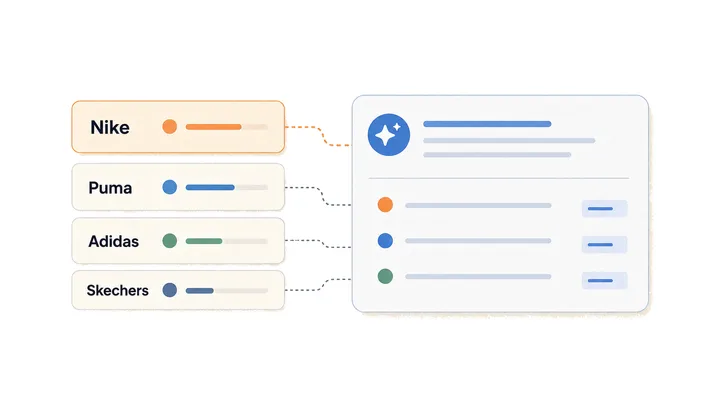
Use competitor visibility gap analysis to separate global competitors from language-specific competitors. Otherwise, your AI share of voice report will average away the problem.
The brand description changes
A brand can be accurately described in English and flattened in another language.
Common failure patterns include:
- The product is described as a generic SEO tool instead of an AI visibility monitoring tool.
- The company name is confused with a similarly named local business.
- The answer uses an old product description from a stale directory.
- The system translates product categories awkwardly, then recommends the wrong alternatives.
- Local-language content exists, but it is thin, outdated, or blocked from indexing.
This is where multilingual AI brand monitoring overlaps with commercial harm. If the local answer gets your category wrong, the buyer may never ask the follow-up question that would fix it.
The prompt intent changes
Some English prompts do not have clean local equivalents.
“AI visibility tracking” may map to “monitoring widocznosci w AI” in Polish, but a real buyer might ask “czy ChatGPT poleca nasza marke” or “jak sprawdzic, czy nasza firma pojawia sie w odpowiedziach AI.” Those are different questions. They produce different answers.
For serious markets, collect prompts from local sales calls, Search Console queries, support tickets, partner pages, competitor copy, and local-language SERPs. Then test those prompts as native prompts, not as translations.
Diagnostic matrix: translate, localize, or rebuild?
Use this matrix before adding a language to your AI visibility tracking workflow.
| Prompt type | Translate | Localize | Rebuild for market |
|---|---|---|---|
| Branded accuracy | Yes, if the brand name is stable | Yes, if product terms differ | Rarely |
| Category discovery | Rarely | Yes | Yes, for mature local markets |
| ”Best tools” prompts | Rarely | Yes | Yes, if local vendors matter |
| Competitor comparison | Sometimes | Yes | Yes, if the competitor set differs |
| Problem-aware prompts | Sometimes | Yes | Yes, if buyers describe pain differently |
| Regulatory or procurement prompts | No | Sometimes | Yes |
| Agency reporting prompts | Sometimes | Yes | Yes, if service packaging differs by country |
Here’s the blunt rule: translate when the fact is stable, localize when the buyer wording changes, rebuild when the market structure changes.
For reporting, keep these buckets separate. A single blended score can hide the exact market where the brand is absent.
How to build a multilingual AI visibility benchmark
Start smaller than your ambition.
Choose three to five markets where the business already cares about pipeline, expansion, agency service coverage, or brand risk. Then build a controlled benchmark for each language.
1. Define the market and language pair
Don’t write “Spanish” and move on.
Write:
- Language: Spanish
- Market: Spain, Mexico, or Latin America
- Buyer: SaaS founder, SEO lead, agency strategist, or product marketer
- Category language: the phrases buyers actually use
- Competitors: global competitors plus local alternatives
- Source types: review sites, local publishers, directories, communities, partner pages, and owned pages
The language alone is not the market.
2. Build native prompt groups
Use the same measurement structure across markets, but not the same wording.
Recommended groups:
- Branded prompts: “What is [brand]?” and “Is [brand] reliable for [use case]?”
- Category prompts: “Best tools for [local category wording].”
- Comparison prompts: “[Brand] vs [competitor]” and “[competitor] alternatives.”
- Problem prompts: “How do I know if ChatGPT recommends my company?”
- Reporting prompts: “How should an agency report AI visibility to clients?”
Then mark each prompt as translated, localized, or market-specific. This one field will save arguments later.
3. Score more than mentions
A multilingual report should not ask only “Did we appear?”
Track:
- Mention presence
- Recommendation quality
- Citation or source presence
- Accuracy of brand description
- Local competitor displacement
- Language quality
- Source freshness
- Whether the answer matches the buyer’s likely intent
The AI share of voice tracking prompt is useful here, but calculate share of voice per language before creating a global rollup.
A brand with 50 percent visibility in English and 5 percent visibility in German does not have a clean 27.5 percent problem. It has a German-market problem.
4. Audit local sources before rewriting pages
Teams love jumping into content production. Slow down.
For each language, list the sources that answer engines cite or appear to rely on:
- Your localized homepage and product pages
- Local-language comparison pages
- Local review sites and directories
- Regional media and partner pages
- Documentation, integrations, plan pages, and support pages
- Community threads, forums, and social profiles where buyers research the category
Then mark each source as accurate, stale, missing, inaccessible, or not in the target language.
This gives the content team a better brief than “write more German AI SEO content.” It tells them which public evidence is missing.
5. Report variance without making it unusable
AI answers vary. Multilingual AI answers vary in more places.
That doesn’t mean the work is useless. It means the report needs discipline:
- Repeat prompts on a set cadence.
- Keep timestamps.
- Separate answer engines.
- Keep language and market fields visible.
- Track trends, not one-off wins.
- Flag low-confidence movement.
- Show examples when a local answer is wrong or competitor-heavy.
For ongoing reporting, connect the multilingual benchmark to recurring AI visibility monitoring. One scan is useful for diagnosis. A recurring scan is what lets a team see whether the market is moving.
The ugly truth: multilingual tracking creates more work
Multilingual tracking is not a free upgrade.
It needs local review. It needs cleaner naming. It needs source QA. It may expose that the company has been treating international markets as translated landing pages instead of separate buyer environments.
Good.
That’s the point of measurement.
The work usually breaks in four places:
- Ownership: no one knows who approves local prompts or local terminology.
- Content debt: the English site is rich, but the local site has thin product pages and old case studies.
- Competitor debt: the team tracks global competitors but misses regional tools, agencies, and directories.
- Reporting debt: leadership wants one number, while the truth lives in language-level trends.
[Operator Note]: If the team cannot name the local buyer phrases and top local competitors, the AI visibility report is not the first problem. The first problem is weak market understanding.
This is also where GEO, or generative engine optimization, should stay grounded. If you need a plain-language framing for the broader discipline, read SEO vs generative engine optimization. Multilingual GEO isn’t a magic layer on top of SEO. It’s the same evidence problem repeated across languages, sources, and buyer contexts.
What to do next
Build the first multilingual AI visibility benchmark in a tight, measurable way.
- Pick three target markets.
- Create 20 to 40 native prompts per market.
- Label each prompt as translated, localized, or market-specific.
- Run the same prompt groups across the same answer engines.
- Track mentions, recommendations, citations, competitors, and accuracy.
- Review local sources before assigning content work.
- Report language-level results before rolling them into a global view.
AI Brand Scan helps teams turn this from scattered local screenshots into a repeatable AI brand monitoring workflow: prompt sets, answers, citations, competitors, and next actions in one place.
Start with one market where local-language visibility matters commercially. If the results show the same competitors and same sources as English, you have evidence. If they do not, you have a roadmap.
FAQ
Is multilingual AI visibility tracking only for global companies?
No. It matters for any company selling into markets where buyers research in more than one language. That includes European SaaS companies, agencies serving international clients, and brands with local-language sales pages.
Can we just translate our English prompt set?
Use translation for stable branded prompts, but do not stop there. Category, comparison, and problem-aware prompts should be localized around local buyer language and local competitors.
Which languages should we track first?
Start with languages tied to revenue, expansion targets, or reputation risk. A small benchmark in German, French, Spanish, or Polish is more useful than a shallow report across 20 languages nobody reviews.
Should multilingual tracking change our content roadmap?
Yes, if the scan finds missing local sources, stale local descriptions, competitor-heavy answers, or thin localized pages. The output should become a GEO content roadmap, not just a visibility score.
How does this relate to classic SEO?
Classic SEO still matters because answer engines use public web information, citations, and source quality signals in different ways. Google’s own AI features optimization guide still points site owners back to core Search fundamentals, while multilingual AI visibility tracking adds another layer: whether generated answers in each language mention, cite, compare, and describe the brand correctly.