Step-by-Step Guide to Dominating AI Search and Boosting Brand Visibility in 2026
- Jowita Chmura
- Ai brand visibility
- Published
- 08 Mins read

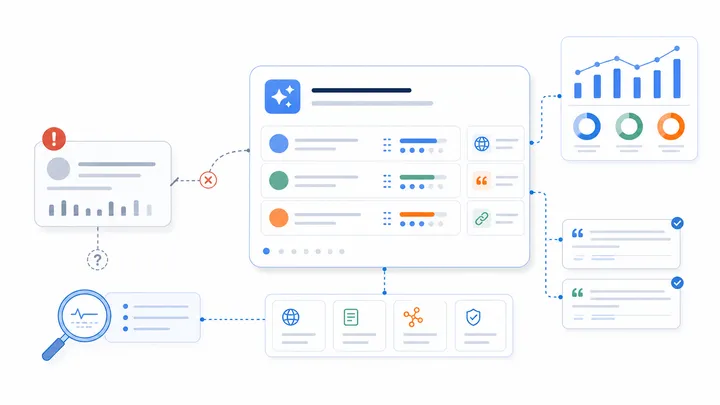
Dominating AI search in 2026 does not mean forcing ChatGPT, Gemini, Perplexity, Claude, Copilot, Grok, or Google AI features to recommend your brand.
It means building a repeatable workflow that makes your brand easier to understand, cite, compare, and monitor when buyers ask AI systems for advice.
The mistake most teams make is treating AI visibility like a new ranking position. It is not. It is a measurement problem across prompts, answer narratives, citations, competitors, and source quality.
[Reality Check]: If your AI visibility strategy is three screenshots from one founder’s ChatGPT account, you do not have a benchmark. You have anecdotes with a timestamp problem.
Key takeaways
- AI search visibility is measured across mentions, recommendations, citations, competitors, and answer accuracy.
- Start with a prompt benchmark before rewriting content. The prompt set is the measurement layer.
- Classic SEO still matters. Google says its foundational SEO best practices remain relevant for AI Overviews and AI Mode.
- GEO work should improve retrievability, evidence clarity, entity consistency, and source quality.
- AI share of voice is useful only when you define the prompt set, competitor set, and denominator.
- One-off screenshots, vague AI SEO rewrites, and traffic-only dashboards will not explain why your brand is absent from buyer shortlists.
Step 1: define the AI search battlefield
Do not start by asking, “How do we rank in AI?” That question drags old SEO thinking into a different interface.
Start with a better question: which buyer decisions should include us?
For a B2B SaaS company, the first benchmark should cover 30 to 60 prompts across five groups.
| Prompt group | Example buyer question | What to measure |
|---|---|---|
| Problem-aware | ”How do I monitor brand mentions in AI answers?” | Does the answer name the problem in language you own? |
| Category | ”Best AI visibility monitoring tools for SaaS teams” | Are you mentioned, recommended, or omitted? |
| Comparison | ”AI Brand Scan vs other GEO tools” | How are you framed against competitors? |
| Alternative | ”Alternatives to manual AI search audits” | Which replacement options appear? |
| Branded trust | ”Is AI Brand Scan good for agency reporting?” | Is the answer accurate, current, and sourced? |
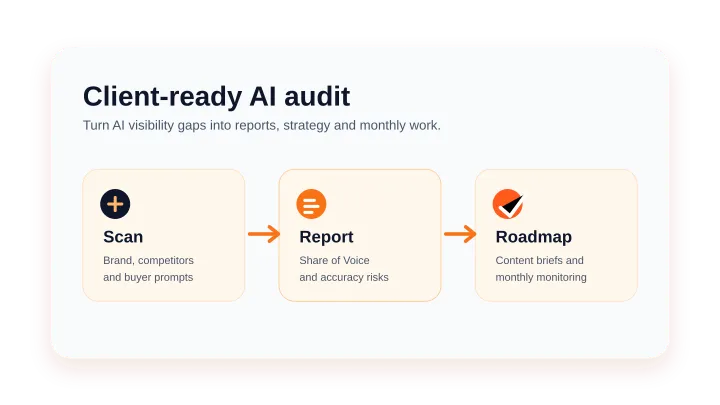
That prompt set becomes your baseline. Run it across the answer engines your buyers may use.
Record the date, platform, visible model or mode, prompt text, answer summary, brand mentions, competitors, citations, wrong claims, and recommended next action.
You are building a comparison asset, not a pile of screenshots.
The fastest starting point is a reusable prompt workflow. Use the AI brand visibility audit prompt to create your first benchmark, then adapt it by market, buyer type, and competitor set.
Step 2: separate mentions, citations, and recommendations
AI search visibility is not one metric.
A brand can be cited but not recommended. It can be mentioned as an option but described with stale positioning. It can be absent from a shortlist while a weaker competitor appears.
Track these outcomes separately:
- Mentioned: the brand appears anywhere in the answer.
- Recommended: the brand is included in a shortlist, buying recommendation, or “best for” answer.
- Cited: the answer links to your owned site or a third-party source about you.
- Accurately described: the product, market, ICP, and use cases match reality.
- Competitor-displaced: another vendor appears where you expected your brand.
- Source-supported: the answer uses credible sources instead of thin directories, stale articles, or unsupported summaries.
This matters because different problems need different fixes.
A missing mention may point to weak category content. A wrong description may point to stale public sources. A competitor-displacement pattern may point to missing comparison pages, reviews, partner pages, or earned media.
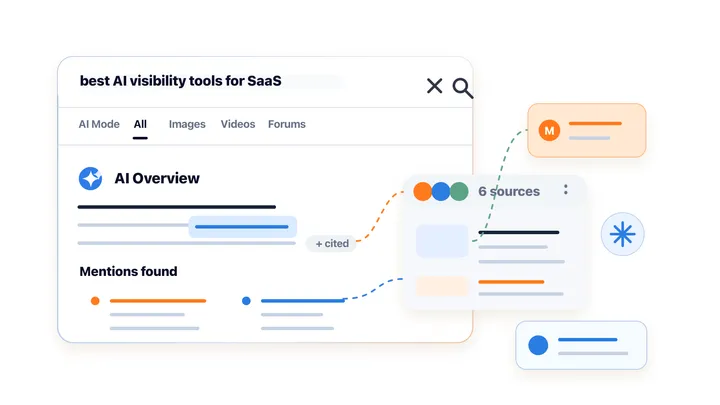
OpenAI’s ChatGPT search announcement made the source layer explicit: ChatGPT search can include links to web sources and a sources sidebar.
OpenAI’s crawler documentation also separates OAI-SearchBot for search features, GPTBot for training, and ChatGPT-User for user-triggered actions. See the OpenAI crawler docs.
The practical lesson is simple: source eligibility, source quality, and robots controls now belong in the AI visibility conversation.
Step 3: audit the sources AI systems can use
Most teams jump straight to rewriting blog posts. Slow down.
Before you rewrite, audit the public source graph around your brand:
- Owned pages: homepage, product pages, comparison pages, pricing, use cases, docs, changelog, case studies, FAQ, and About page.
- Third-party pages: review sites, directories, analyst pages, partner profiles, marketplace listings, media coverage, podcasts, YouTube descriptions, and LinkedIn company information.
- Community pages: Reddit threads, forum answers, Quora-style pages, GitHub discussions, and niche communities.
- Structured facts: Organization schema, SoftwareApplication schema where relevant, author data, product names, sameAs links, social profiles, and canonical URLs.
- Technical access: robots.txt, noindex, snippet controls, CDN bot rules, JavaScript-rendered content, broken pages, redirects, and sitemap freshness.
Google’s AI features guidance for site owners is a useful guardrail here.
Google says the same foundational SEO practices apply to AI Overviews and AI Mode. Pages need to be indexed and eligible for a snippet to appear as supporting links, and Google says no special schema.org markup is required.
In plain English: do not invent an “AI schema” project before your crawlability, internal links, textual content, and visible structured data are sane.
Your source audit should produce a short list of blockers:
- Important product facts are trapped in images, JavaScript, PDFs, or sales decks.
- Third-party profiles describe an old ICP, old pricing, old features, or a retired category.
- Competitors have better comparison and “best tools” coverage.
- Owned pages explain features but not buyer situations.
- Public proof is thin: no customer examples, integrations, use cases, benchmarks, or credible mentions.
This work is not glamorous. It is the part that makes answer engines less likely to guess.
Step 4: build GEO content around evidence, not keywords
Generative Engine Optimization, or GEO, works best when it makes your brand easier to retrieve, cite, and use inside an answer.
Keyword coverage helps, but a page that only repeats “AI search visibility” is not much of a source.
Build pages that answer the questions an assistant must resolve before recommending a vendor:
- What does the product do?
- Who is it for?
- Which use case is it strongest for?
- Which alternatives should a buyer compare?
- What are the limits?
- Which integrations, workflows, languages, markets, and reporting needs does it support?
- What proof exists outside the brand’s own website?
For AI Brand Scan, that means content about AI visibility audits, prompt monitoring, competitor visibility gaps, AI share of voice, source analysis, and recurring reporting.
A strong GEO page should contain direct definitions, comparison tables, implementation notes, FAQs, and source-backed claims where needed.
Use this page pattern:
| Page type | Job in AI search | Required evidence |
|---|---|---|
| Category guide | Helps the system explain the market | Definitions, use cases, decision criteria |
| Use-case page | Maps the brand to a buyer situation | Workflow, inputs, outputs, objections |
| Comparison page | Clarifies when to choose one option | Product differences, trade-offs, neutral criteria |
| FAQ page | Answers assistant-friendly follow-up questions | Short answers, caveats, internal links |
| Report template | Shows operational maturity | Metrics, cadence, owner, action plan |
The GEO content roadmap prompt can turn observed answer gaps into briefs instead of random topic ideas.
That is the difference between “write more AI SEO content” and “fix the pages that explain why agencies use us for recurring AI visibility reports.”
Step 5: measure AI share of voice honestly
AI share of voice is useful when you define it narrowly.
It should not mean “our total presence across the whole AI internet.” That is theater.
Use it like this:
AI share of voice = your qualified mentions divided by all qualified vendor mentions in a defined prompt set.
For example, imagine you test 40 category and comparison prompts across three answer engines. If the answers include 120 qualified vendor mentions and your brand appears 18 times, your AI share of voice is 15% for that benchmark.
Keep the denominator visible. Segment by prompt group. Show competitors.
Then add quality fields:
- Was the brand recommended or merely listed?
- Was the mention accurate?
- Was the answer positive, neutral, or cautionary?
- Which citation supported the mention?
- Did the answer name a competitor feature as the reason for recommendation?
Perplexity’s Search API documentation shows why source handling needs this discipline.
Search outputs can include result URLs, dates, last_updated values, domain filters, regional search controls, and context-size controls. Even outside that API, the operating lesson is the same.
AI search work depends on query design, source selection, freshness, and extracted context. It is not only page-level SEO.
Step 6: turn competitor visibility into tasks
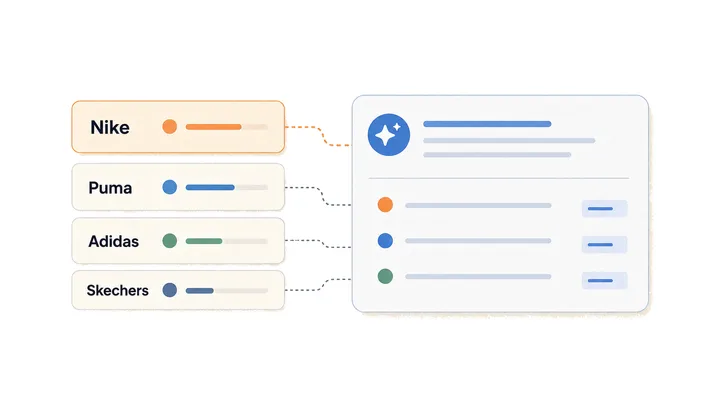
Competitor mentions are not just bad news. They are market research.
When an answer recommends three competitors and leaves you out, classify the reason before assigning work:
- Category mismatch: the system does not connect your brand to the buyer’s problem.
- Proof gap: the competitor has stronger third-party evidence.
- Comparison gap: the competitor appears in more “best tools,” alternative, or versus pages.
- Entity gap: your product name, company name, category, and URLs are inconsistent.
- Freshness gap: stale public sources describe an older version of your product.
- Language or market gap: the competitor is better represented in the buyer’s local language.
Then turn each finding into a task.
If the gap is comparison coverage, write or improve comparison pages. If the gap is stale source data, update profiles and request corrections. If the gap is prompt-specific, create a page that answers that buyer situation directly.
For a practical workflow, use competitor visibility gap analysis and compare the findings with your existing SEO priorities.
Sometimes the fix is a classic page update. Sometimes it is a source strategy problem. Often, it is both.
Step 7: create a monthly AI visibility rhythm
The work breaks when nobody owns it.
Assign one owner for the benchmark, one owner for content fixes, and one owner for source cleanup. In a small company, that may be the same person. In an agency, it may be a strategist plus a content lead.
Use this cadence:
| Timing | Work |
|---|---|
| Week 1 | Run the prompt benchmark and capture answers. |
| Week 1 | Flag missing mentions, inaccurate descriptions, competitor displacement, and weak citations. |
| Week 2 | Prioritize fixes by revenue relevance and effort. |
| Week 2-3 | Publish or update the highest-impact content and source assets. |
| Week 4 | Rerun the benchmark, compare movement, and prepare the report. |
The report should fit on one executive page before the appendix.
| Reporting field | What leadership needs to see |
|---|---|
| Visibility trend | Did mentions, recommendations, or accuracy improve? |
| Competitor movement | Who gained or lost presence in buyer prompts? |
| Source quality | Which sources shaped answers? |
| Risk | Which wrong claims or stale descriptions still appear? |
| Next actions | Which pages, sources, or prompts will be fixed next? |
This is where recurring AI visibility monitoring for B2B SaaS becomes more useful than a one-time audit.
One scan finds the problem. Repeated scans show whether the work is changing the pattern.
The ugly truth: AI visibility is influenced, not controlled
No serious AI brand monitoring workflow should promise guaranteed mentions.
AI answers vary by platform, date, prompt wording, location, personalization, source availability, and product changes.
Some answers cite sources. Some synthesize without obvious attribution. Some include competitors because the public web gives the system more confident evidence about them.
That uncertainty is not a reason to ignore AI search. It is a reason to measure it properly.
If you want better brand visibility in AI answers, do not chase tricks.
Build a benchmark, clean up the source graph, publish evidence-rich pages, monitor competitors, and report movement over time.
Then use AI Brand Scan to turn those observations into a repeatable audit and roadmap instead of another spreadsheet nobody trusts.
FAQ
What is the fastest way to improve AI search visibility?
The fastest useful step is not a rewrite. Build a prompt benchmark, run it across the answer engines your buyers use, and identify whether the problem is missing mentions, weak citations, inaccurate descriptions, or competitor displacement.
Then fix the highest-revenue prompt group first.
Is GEO replacing SEO in 2026?
No. GEO extends SEO into AI-generated answers.
Crawlability, useful content, internal links, structured data, brand authority, and third-party sources still matter. The difference is the measurement layer: prompts, answer narratives, citations, recommendations, and competitor presence.
How many prompts should a company monitor?
Start with 30 to 60 prompts for one product category.
That is enough to cover problem, category, comparison, alternative, and branded trust prompts without creating a reporting mess. Larger brands and agencies can expand by market, language, product line, and competitor set.
Can AI Brand Scan guarantee that ChatGPT or Google AI Overviews will mention my brand?
No. AI Brand Scan helps teams measure AI search visibility, find visibility gaps, monitor competitors, and prioritize GEO fixes.
It should be used as an evidence and workflow layer, not a guarantee engine.
What should go into an AI visibility report?
Include the prompt set, answer engine, date, brand mentions, recommendations, citations, competitor mentions, inaccurate claims, source patterns, AI share of voice, and prioritized fixes.
Keep the executive summary short. Put raw answer captures in the appendix.
What to do next
Start with a benchmark before you rewrite anything.
Run the AI brand visibility audit prompt, check the AI share of voice tracking workflow, and use AI Brand Scan to turn visibility gaps into a repeatable monitoring report.