How to Track Competitors in AI Search Results
- Jowita Chmura
- Ai brand visibility
- Published
- 09 Mins read
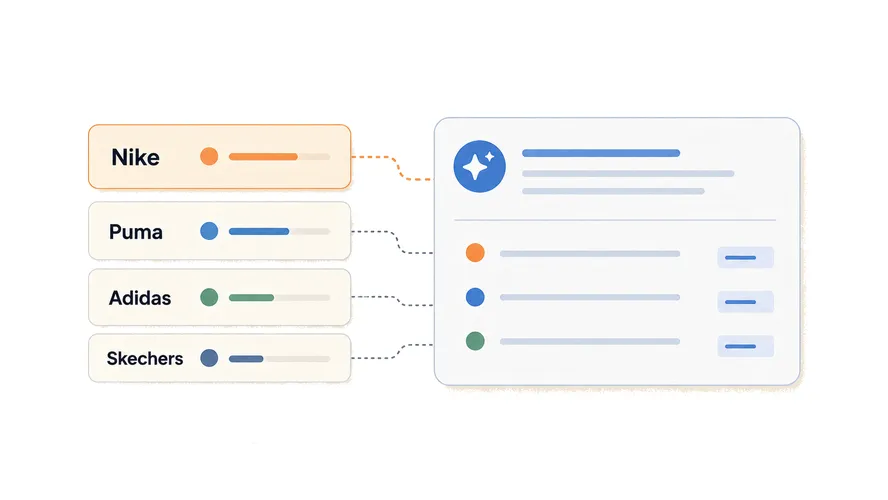
How to Track Competitors in AI Search Results
To track competitors in AI search results, you should use a repeatable prompt benchmark that records competitor mentions, recommendations, citations, and source quality over time. The business risk is simple: if answer engines recommend rival brands for buyer-intent prompts and omit yours, you may lose the shortlist before a visitor reaches your site.
Most teams ask the wrong first question: “Where do we rank in ChatGPT?” That drags classic rank tracking into a surface that does not behave like ten blue links.
[Reality Check]: If your competitor report is five screenshots from one afternoon, you don’t have AI competitor analysis. You have a few anecdotes with a timestamp.
Key takeaways
- Track competitors in AI search results by prompt group, not by one generic query.
- Separate mentions, recommendations, citations, and answer framing. They point to different fixes.
- Measure competitor visibility in AI search as a trend because answers can change by platform, date, wording, location, and source availability.
- Use AI share of voice only after you define the prompt set, competitor set, and denominator.
- Source gaps matter. A competitor may win because AI systems can find clearer third-party evidence about them.
- The best output is a monthly action report: which competitors gained visibility, why they may have gained it, and what your team will fix next.
Why competitor tracking in AI search is different
Traditional competitor SEO asks whether a rival outranks you for a keyword. AI search competitor tracking asks a messier question: when a buyer asks an answer engine what to buy, who does the system trust enough to name?
That means you need to monitor four surfaces at once:
- The answer text: Which competitors appear, how they are described, and whether your brand appears at all.
- The recommendation logic: Which vendor is named as “best for” a use case, budget, market, role, or company size.
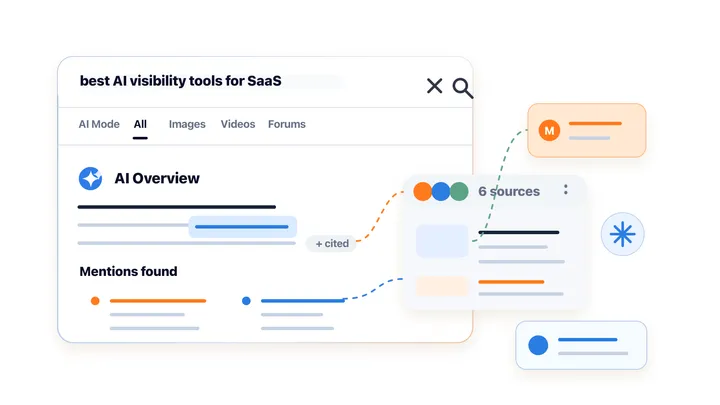
- The citation layer: Which owned, third-party, review, directory, media, or community sources support the answer.
- The narrative gap: Whether the answer explains a competitor more clearly than it explains you.
OpenAI’s ChatGPT search announcement makes the source layer visible: ChatGPT search can answer with links to web sources and a sources sidebar. Google has its own AI search surfaces, and Google Search Central’s AI features guidance tells site owners to think about indexing, preview controls, and what Googlebot can see.
The practical point: competitor tracking in AI search is partly SEO, partly positioning, partly source hygiene, and partly reporting discipline.
Start with the competitor prompt set
Don’t start by typing your brand name into ChatGPT and hoping for a clean answer. Start with the buyer decisions you care about.
For a B2B SaaS company, build 30 to 60 prompts across six groups:
| Prompt group | Example prompt | What to track |
|---|---|---|
| Category discovery | ”Best AI visibility tools for B2B SaaS teams” | Which vendors appear in the shortlist |
| Use case | ”Which tools help agencies report AI search visibility to clients?” | Which competitor owns the buyer situation |
| Comparison | ”Compare [your brand] and [competitor] for AI brand monitoring” | Whether the answer gives each vendor a fair role |
| Alternative | ”Best alternatives to [known competitor] for AI share of voice tracking” | Which replacement options appear |
| Constraint-rich | ”I need an AI search monitoring tool for a European SaaS company with multilingual reporting” | Whether competitors win on region, language, integration, or workflow |
| Branded trust | ”Is [your brand] reliable for competitor visibility gap analysis?” | Whether the answer is accurate and current |
Use the same prompt set on the answer engines your buyers may use: ChatGPT, Perplexity, Gemini, Claude, Copilot, and Google AI features where they are available in your market.
Then run the same prompts again on a fixed cadence. Weekly is enough for most teams. Monthly can work for slower-moving categories. Daily manual checks create more noise than insight unless you have a specific launch, PR issue, or competitor event to watch.
For a faster starting point, adapt the AI competitor visibility gap prompt to your market, buyer type, and named competitor set.
Track the metrics that explain why competitors appear
Do not reduce the report to “they appeared, we didn’t.” That tells leadership something is wrong, but it does not tell the team what to fix.
Track these fields for every prompt run:
- Mention: Did the competitor appear anywhere in the answer?
- Recommendation: Was the competitor included in a shortlist, ranked list, or “best for” answer?
- Positioning: What reason did the answer give for choosing or naming the competitor?
- Citation: Which sources were shown, linked, or implied by the answer?
- Accuracy: Did the answer describe your brand and the competitor correctly?
- Displacement: Did a competitor appear in a prompt where your brand should have been a natural option?
- Category ownership: Which competitor appears across the highest-value prompt group?
- Competitive vacuum: Which prompt group has no clear winner yet?
That last metric is useful. A prompt where every answer is vague or inconsistent may be an opening for a better category guide, comparison page, use-case page, or third-party source.
You can calculate a simple AI share of voice:
AI share of voice = your qualified vendor mentions / all qualified vendor mentions in the defined prompt setKeep it narrow. “We have 18% AI share of voice for 40 agency-reporting prompts across three answer engines” is useful. “We own 18% of AI search” is theater.
The AI share of voice tracking workflow is the better model: define the prompt set, count qualified mentions, segment by buyer intent, and show competitors beside you.
Deep dive: score competitor visibility by prompt intent
The scoring mistake is treating every prompt as equal.
A competitor mention in a generic education prompt is not the same as a recommendation in a high-intent buying prompt. A citation from a stale directory is not the same as a current source that explains the category with buyer criteria.
Use a weighted scorecard:
| Field | Weight | How to score it |
|---|---|---|
| Buyer intent fit | 0-5 | Does this prompt map to a real buying decision? |
| Competitor recommendation | 0-5 | Is the competitor only named, or actually recommended? |
| Your brand visibility | 0-5 | Are you absent, mentioned, recommended, or cited? |
| Source quality | 0-5 | Are sources current, credible, and relevant to the prompt? |
| Narrative strength | 0-5 | Does the answer explain why a buyer should choose that vendor? |
| Error risk | 0-5 | Are there stale claims, invented features, or wrong positioning? |
Then multiply the score by prompt importance.
A prompt like “best AI visibility tools for agencies” may deserve a 3x multiplier if agencies are a target segment. A broad prompt like “what is AI search?” may deserve 1x because it helps category awareness but does not reveal the same competitive pressure.
This keeps your team from chasing low-value movement.
It also helps with internal politics. If sales wants every competitor mention fixed, the scorecard gives you a calm way to say: “This one matters because it shows up in buyer shortlist prompts. That one is a curiosity.”
Audit the sources behind competitor recommendations
Competitors usually do not appear out of nowhere. The answer engine is working with a public evidence layer: owned pages, third-party pages, docs, reviews, listicles, directories, social profiles, community discussions, and whatever the current search system can retrieve.
For every competitor that appears more than once, record the source pattern:
| Source type | What to check | Possible fix |
|---|---|---|
| Competitor owned site | Does their site state category, audience, use cases, and proof more clearly than yours? | Rewrite your source-of-truth pages around buyer questions |
| Third-party listicles | Are competitors present in “best tools” pages where you are absent? | Build a PR, partner, or editorial outreach list |
| Review and directory pages | Are profiles current, complete, and category-aligned? | Update owned profiles and request corrections where possible |
| Comparison content | Do competitors have clearer versus and alternatives pages? | Create balanced comparison pages with real criteria |
| Community threads | Are buyers using language your site ignores? | Add FAQ and use-case language that mirrors real objections |
| Documentation or API pages | Does the competitor expose technical proof your site hides? | Make integrations, workflows, and limits easier to inspect |
Perplexity’s Search API documentation shows why this source layer deserves attention: search systems can expose result URLs, date handling, recency filters, and domain filtering. Even if you are not using that API, the operating lesson holds.
AI competitor tracking depends on query design, source selection, freshness, and extractable evidence. It is not only a blog rewrite project.
This is also where a manual DIY AI SEO brand audit helps. Before you decide what to publish, find the sources answer engines already use for your category and competitors.
Turn competitor gaps into actions
Once you have prompt-level findings, classify each gap by the work it requires.
| Gap type | What it looks like in AI answers | Fix |
|---|---|---|
| Category gap | Competitors are named for the category and you are absent | Clarify category language on homepage, product pages, and use-case pages |
| Proof gap | Competitors are recommended because the answer can name evidence | Publish customer examples, workflows, integrations, benchmarks, or credible third-party proof |
| Comparison gap | Competitors dominate alternatives and versus prompts | Create comparison pages that help buyers choose fairly |
| Source gap | Answers cite outdated or weak sources about you | Update profiles, directories, partner pages, and stale public descriptions |
| Entity gap | AI systems confuse product name, company name, category, or URL | Align naming, schema, about pages, social profiles, and sameAs signals |
| Market gap | A local competitor wins in a language or region you ignore | Build localized prompt sets and market-specific source pages |
Do not copy the competitor because an answer named them. First ask why the answer named them.
If the answer cites a current third-party comparison, the fix may be source strategy. If it mentions a competitor because their homepage states the use case plainly, the fix may be your own product page. If the answer is wrong about both brands, the fix may be measurement, not content.
For a structured workflow, use competitor visibility gap analysis to turn observations into a prompt-level risk map and content roadmap.
[Reporting Template]: monthly AI competitor visibility report
Keep the executive report short. Put screenshots, full answer captures, and raw prompt logs in the appendix.
| Report field | What to include |
|---|---|
| Benchmark scope | Date range, answer engines, prompt groups, markets, language, and competitor set |
| AI share of voice | Qualified mentions by brand, segmented by prompt group |
| Recommendation share | How often each competitor was actually recommended, not just named |
| Displacement prompts | Prompts where competitors appeared and your brand was absent |
| Source patterns | Owned, third-party, review, directory, community, and comparison sources that shaped answers |
| Accuracy risks | Wrong claims, stale positioning, invented features, or missing disclaimers |
| Competitive vacuums | High-value prompts where no vendor owns the answer yet |
| Priority fixes | Three to five actions with owner, due date, and expected prompt group impact |
Add one plain-English summary at the top:
“Competitor A gained recommendation share in agency-reporting prompts because answer engines found clearer third-party proof and comparison content. Our highest-value fix is to publish an agency reporting use-case page, update two directory profiles, and rerun the same prompt group next month.”
That is a report a CMO can act on.
A dashboard full of unstable answer snippets isn’t enough. The value is the decision: which competitor pattern matters, what caused it, and what the team will do next.
The ugly truth: competitor tracking will stay noisy
AI search results are not stable rankings. They can shift with prompt wording, model changes, source freshness, crawler access, localization, and the answer engine’s own retrieval process.
That does not make tracking useless. It means the methodology has to admit uncertainty.
Use repeated prompts. Keep timestamps. Capture source links when available. Segment by buyer intent.
Watch trends, not single outputs. Treat sudden changes as a signal to investigate, not a victory lap or a panic button.
This is where recurring AI SEO monitoring becomes more useful than a one-time audit. One scan can find a competitor gap. Repeated scans show whether the gap is persistent enough to justify work.
What to do next
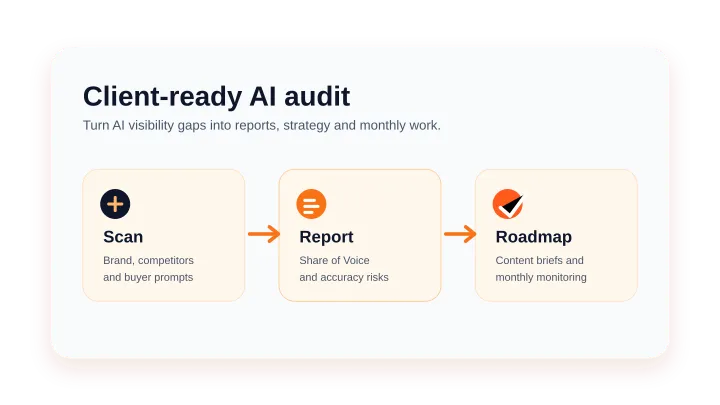
Start with one product category, one market, five competitors, and 30 buyer-intent prompts. Run the benchmark across the answer engines your buyers may use, then classify every competitor appearance by mention, recommendation, citation, displacement, and source quality.
After that, pick the three fixes with the clearest business consequence. A wrong branded answer, a competitor winning a high-intent shortlist prompt, and a stale third-party source should beat cosmetic wording changes.
Use AI Brand Scan to move from manual screenshots to repeatable AI search reporting. The goal isn’t to prove that AI search is perfectly measurable. The goal is to see where competitors are getting recommended, why the answer may trust them, and which source or content gap you can fix first.
FAQ
What is competitor visibility in AI search?
Competitor visibility in AI search is the presence of rival brands in AI-generated answers for category, comparison, alternative, and buyer-intent prompts. It includes mentions, recommendations, citations, answer framing, and source quality.
How many competitors should I track?
Start with three to five named competitors plus any unexpected brands that appear repeatedly. If you track too many names at the start, the report becomes hard to interpret.
How often should I monitor AI competitor results?
Weekly is enough for most active SaaS and agency teams. Monthly works for slower categories. Run extra checks after major launches, pricing changes, PR coverage, product repositioning, or competitor announcements.
Can competitor tracking improve AI search visibility?
It can improve the work you choose. Competitor tracking does not force answer engines to mention your brand, but it shows which prompt groups, sources, claims, and comparison gaps deserve attention.
Is this the same as SEO competitor tracking?
No. SEO competitor tracking focuses on rankings, pages, backlinks, and traffic. AI competitor tracking focuses on generated answers: who gets named, recommended, cited, compared, and trusted in the answer itself.